SEO + GEO agency · B2B & SaaS

Found in Google. Cited by the LLMs.

AI SEO done right: we get your site found in Google and Bing, and your brand cited in ChatGPT, Perplexity, Claude, and Gemini answers. By the end, you own a content production system one in-house person can run.

Get a free audit
  • 25% of info queries now go through AI
  • 800M weekly ChatGPT users
  • 72% of citations use answer capsules
02 What changed

Search split into
5 channels

Ten years ago there was one channel: Google. Today the same person gets answers from five different systems, each with its own rules for who gets cited. A strategy built for one platform covers about 11% of the traffic that's actually out there.

Scroll sideways
01

Classic Google

When an AI Overview sits at the top of the page, the CTR for position #1 drops. Gartner expects traditional search traffic to fall further by the end of 2026.

Source Ahrefs, April 2025 · 300,000 keywords. Gartner, February 2024.
−34.5% CTR drop for #1 with an AI Overview
−25% projected drop by 2026
02

Google AI Overviews

AI Overviews now show up on a quarter of all queries. Brands cited inside those answers see organic CTR climb by 35%.

Source Conductor 2026 AEO/GEO Benchmarks · 21.9M queries. Seer Interactive, September 2025.
25.11% queries trigger an AI answer
+35% CTR lift when cited
03

ChatGPT with search

800 million weekly users. 87% of ChatGPT citations overlap with top Bing results, which is why being indexed in Bing is non-negotiable now.

Source OpenAI Dev Day, October 2025. Seer Interactive, February 2025 · 500+ citations.
800M weekly users
87% overlap with top Bing
04

Perplexity

780 million queries a month, real-time RAG. Every answer pulls 5–8 sources from about 7 unique domains and links each one. Recency is heavily weighted.

Source Aravind Srinivas, Bloomberg Tech Summit, June 2025. Single Grain 2025.
780M queries a month
5–8 sources per answer
05

Claude, Copilot, DeepSeek

Each system favors its own set of sources. ChatGPT alone now drives 10% of new sign-ups on Vercel. That's an acquisition channel, not an experiment.

Source Vercel CEO Guillermo Rauch, April 2025.
10% of new Vercel sign-ups from ChatGPT
11% overlap between ChatGPT and Perplexity
Terminology

What's the difference

The industry hasn't settled the vocabulary. The same work goes by four names: GEO, AEO, LLMO, AI SEO. In practice we run all four as services — GEO, AEO, AI SEO and LLMO — because they only work together. Skip the SEO foundation and the other layers give you nothing back — AI systems pull from the Google and Bing index, so if you're not in there, you're invisible to them too.

SEO Search Engine Optimization

The classic. Optimization for Google and Bing. Goal: top-10 positions and clicks from the SERP.

Role Foundation. Without solid SEO, the site never reaches the index AI systems pull from.
AEO Answer Engine Optimization

Optimization for direct answers inside Google and Bing. Goal: own position zero — the featured snippet.

Role A subset of SEO, tuned for short-answer formats.
GEO Generative Engine Optimization

Optimization for brand mentions inside ChatGPT, Perplexity, Claude, and Gemini answers. Goal: become a source the AI cites.

Main point Not about clicks. About showing up inside the answer.
LLMO Large Language Model Optimization

The technical sub-layer of GEO. Structuring data so LLMs can pull it cleanly and cite it without distortion.

Role Schema.org, semantic HTML, crawler access.

SEO is the foundation. GEO is the finish.

Without a foundation, the finish falls off. With a foundation but no finish, you lose every buyer who would have picked you through an AI answer.

Princeton / Georgia Tech (Aggarwal et al., KDD 2024): 40% of GEO ranking factors overlap with classic SEO. The other 60% are specific to extraction, authority, and brand mentions.

What we do

Three levels of work

01 02 03 / 03
01 — SEO

Classic SEO

The foundation. Without it, AI systems can't see your brand at all. B2B and SaaS SEO: keyword research, technical SEO, site architecture, Schema.org, hreflang, link building.

We do it
  • Keyword research and content strategy
  • Site architecture and Schema.org markup
  • Internal linking and link building
We audit, you keep
  • Core Web Vitals and page speed
02 — GEO

GEO for AI search

As a GEO agency we run generative engine optimization services — structuring content so LLMs can extract it cleanly. Answer capsules, FAQ blocks, declarative tone, dated citations.

61% vs 37% Declarative structure gets cited by AI in 61% of cases. Narrative structure: 37%.
Source: GEO Lab Experiment 2026
  • Brand signals on the third-party sources AI treats as authoritative
  • Coverage across 6 AI platforms: ChatGPT, Gemini, Perplexity, Claude, Copilot, Mistral
03 — LLMO

Technical artifacts

The files that let AI systems read your site correctly. "LLM-readability" becomes an engineering job.

  • Schema.org / JSON-LD — structured data AI systems use to understand the page
  • robots.txt — explicit access for 7 key AI crawlers (GPTBot, ClaudeBot, and the rest)
  • SSR + IndexNow — instant indexing in Bing, where ChatGPT pulls from
  • Entity consistency — brand data matched across LinkedIn, Crunchbase, and directories
Stack

Under the hood

We use off-the-shelf tools where they work and build custom ones where they give a real edge. The custom tools stay with the client when the project ends. JavaScript SEO is part of the routine: we render JS content the way crawlers do and verify the bots can actually read it.

01

Keyword and content research

  • Ahrefs
  • Semrush
  • Screaming Frog
02

Analytics and indexing

  • Google Search Console
  • Google Analytics 4
  • Bing Webmaster Tools
  • DataForSEO
03

AI citation tracking

  • Ahrefs Brand Radar
  • Otterly.ai
  • Profound
  • Semrush AI Toolkit
04

Schema validation

  • Google Rich Results Test
  • Schema Markup Validator
05

Speed and Core Web Vitals

  • PageSpeed Insights API
  • Lighthouse CI
  • WebPageTest
Custom · built per client

What the client keeps when we're done

Alongside the off-the-shelf platforms, we build internal tools for the client's specific workflows. They live inside the client's stack and stay there after the project closes.

  • 01
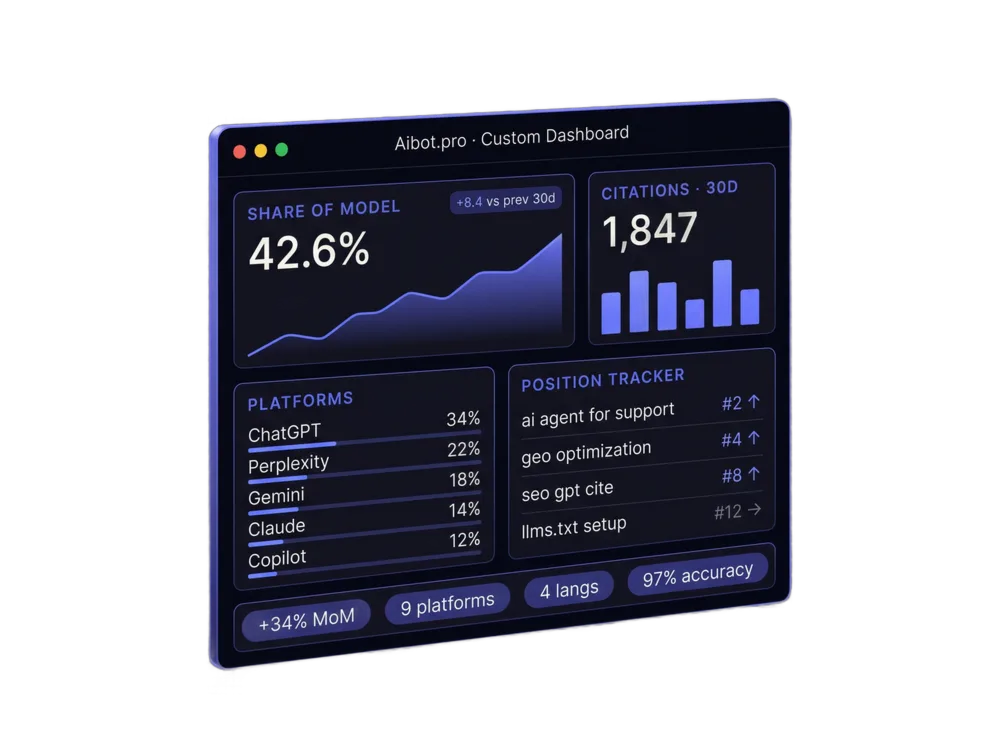
    Custom dashboard. Positions, AI citations, organic traffic, Core Web Vitals, share of model — one panel instead of seven open tabs.
  • 02
    AI brand monitoring. Runs your priority query set against every target AI platform on a schedule and tracks where you get cited, month over month.
  • 03
    Content generator. Built on top of an analysis of what currently ranks and what AI systems cite in your space.

Some projects need extra tooling beyond this. We work that out during the architecture phase.

Process

From audit to handoff

Hover a row to expand the phase.

01 Foundation

Data-driven keyword research. Technical audit of the existing site, or planning from scratch if there is no site. Schema.org markup, hreflang, robots.txt configured with explicit access for AI crawlers.

  • Register the site in Google Search Console and Bing Webmaster Tools
  • Hook up Microsoft's AI Performance Report
  • Stand up the custom tools: dashboard, rank tracking
02 Authority

Content production against the priority clusters from the keyword research. Every page is structured for extraction: answer capsule right after each H2, FAQ blocks, tables, Schema.org Article + FAQPage.

  • Brand signals placed on the sources AI systems treat as authoritative in your space
  • Build the content generator the client uses to produce articles without us in the loop
03 Handoff

Expand content coverage. Programmatic landing-page generation from the client's own data, where it fits the category.

  • System handoff: documentation, content generator tuned to the client's brand
  • Two training sessions with the in-house owner who carries the work forward
  • Final report and the move to post-project support

3–6 months

Standard project length depending on scope and complexity. When the project ends, the client runs the system in-house — without a subscription or agency lock-in.

What you keep

What the client walks away with

  1. 01

    A solid technical base

    Structured data for Google and Bing, access for AI crawlers, fast indexing.

  2. 02

    Content built to get cited

    Published pages on your priority queries, written in the formats AI systems cite the most.

  3. 03

    Custom tools

    Dashboard, rank tracker, AI brand monitoring across AI answers — inside the client's stack, with documentation.

  4. 04

    A content generator tuned to the brand

    An internal tool: someone on the team clicks "write a guide on topic X" and gets a draft in the brand voice, structured for AI citation. Style guide and a library of proven formulas live inside the tool.

  5. 05

    A trained in-house owner

    Runs the process after we step out. Two training sessions and a final report close the handoff.

Metrics

What we measure

The old SEO metrics stay: positions, CTR, organic traffic. We add new KPIs for AI visibility on top. We don't promise specific traffic or rank numbers. Anyone guaranteeing "top-3 in 3 months" either doesn't know how SEO works or is lying.

New GEO KPIs

01 King KPI

Share of Model · SoM

The share of category answers that mention your brand. Calculated against a fixed list of priority queries, run regularly across every target AI platform. The king metric for GEO.

  • fixed priority query set
  • run against every target platform
  • tracks share of mentions over time
02

Citation Frequency

Raw count of brand mentions and links to your site inside AI answers. Broken out per platform.

03

Context Accuracy

Whether AI gets your services, focus area, and region right. Hallucinated facts are a signal to fix entity consistency.

04

Prompt Coverage

Share of target search intents covered by content the AI can actually extract and cite.

05 Bottom line 4.4× conversion vs organic Google

AI Referral Traffic

Real clicks from AI platforms, captured through GA4 custom dimensions. The visitor lands already past the decision — shorter sales cycle, higher average order value (Semrush, June 2025).

What stays

The foundation stays

The old SEO metrics aren't going anywhere. We add AI visibility on top of them.

01
Google positions
Ahrefs · Search Console
02
Organic traffic
GA4 · Search Console
03
SERP CTR
especially after an AI Overview
04
Backlink profile
Ahrefs Brand Radar
05
Core Web Vitals
PageSpeed · Lighthouse
Anti-patterns

What we avoid

Six things we skip by default on every project. Most are mistakes we see repeated across clients who come to us after a failed first attempt.

01

AI crawlers blocked in robots.txt

Sites built a few years back often ship with robots.txt that blocks GPTBot, PerplexityBot, and Google-Extended by default. AI systems physically can't read the content. First check on any audit: open robots.txt and make sure AI bots are explicitly allowed.

02

Template AI-generated content

A company orders 100–200 AI-generated articles with the brand name sprinkled in. AI systems detect the template and ignore that content when building answers. Real example from 2025: 150 articles, zero results, not a single one cited by ChatGPT or Perplexity.

03

Inconsistent entity data

Company name spelled one way on the site, another on LinkedIn, a third on Crunchbase. AI cross-references entity data across sources. When the data doesn't line up, the entity reads as ambiguous and doesn't get cited. Reconciling brand data is a required step in our process.

04

Content with no date or author

ChatGPT and Perplexity weigh recency and authority heavily in 2026. Content with no datePublished, no author with a verified bio, no updates — it loses its shot at being cited.

An update within 30 days drives 3.2× more citations. ConvertMate GEO Benchmark 2026

05

Optimizing for one platform only

"Let's crack ChatGPT first, then think about the rest" doesn't work. Only 11% of domains get cited in both ChatGPT and Perplexity. Multi-platform work from day one gives the best composite result.

06

"Google rank" as the only KPI

You can hold the #1 spot in Google and still never appear in the ChatGPT answer for the same query.

Overlap between Google top results and AI-cited sources dropped from 70% to under 20% across 2024–2025. Brandlight / 5W Research, May 2026

Pricing

Transparent pricing

Prices are locked at the time of booking. Bundle a new site with optimization and you get a discount. We agree on the amount once we know the scope.

Start · Foundation Hypothesis check
from €2,500 one-time
  • SEO/GEO audit of the existing site
  • Schema.org on key pages, robots.txt + llms.txt, hreflang
  • Keyword research, registration in Search Console and Bing
  • For: a business with a site that needs to build a technical base for growth in search
Choose Start
Enterprise · Authority Regulated industries · larger teams
from €12,000 one-time
  • Everything in Business
  • Programmatic landing-page generation for cities, products, and industries
  • 4+ languages with local SEO versions
  • Digital PR: active placement on external sites and in industry publications, targeted advertising
  • Extended custom tooling
  • For: a business that needs to dominate several markets and languages, become a recognized expert in its industry
Let's talk
Monthly retainer (optional)
Full cycle €800–1,500/mo We run SEO/GEO content for your site: articles that land in Google and AI search results. We write, publish, and track positions — you just get the traffic.
Authority €1,500+/mo We run the site and social channels end to end. Every month we create and publish content with the MindMap Content Method — our own approach where AI first maps how your audience thinks, then builds content that leads to a purchase.

at +60% traffic growth, 1.5% conversion, €300 per customer · An estimate, not an offer

extra revenue per month
FAQ

Common questions

If your question isn't here, write the CTO or CEO directly. We reply within 24 hours.

01 What is GEO, and how is it different from SEO?

GEO (Generative Engine Optimization) is optimization for brand mentions inside ChatGPT, Perplexity, Claude, and Gemini answers. SEO works on positions in Google and Bing; GEO works on showing up inside the AI answer. The Princeton/Georgia Tech paper (KDD 2024) found 40% of GEO ranking factors overlap with classic SEO — the other 60% are extraction, authority, and brand-mention signals. GEO sits on top of SEO; it doesn't replace it.

02 Is SEO dead?

No. AI systems pull from the Google and Bing index plus real-time crawling — without classic SEO your content never reaches them. What's changing isn't SEO's importance but how answers get consumed: part of the time the user reads the answer inside the AI and never visits a site. So SEO stays the foundation, and GEO adds visibility inside AI answers on top of it.

03 What's the difference between SEO, AEO, GEO, and LLMO?

SEO — positions in Google and Bing. AEO (Answer Engine Optimization) — landing in direct answers and featured snippets inside the search engine. GEO — brand mentions in generative answers (ChatGPT, Perplexity, Gemini). LLMO — the technical sub-layer of GEO: Schema.org, semantic HTML, crawler access. In practice we run all four — they only work together, not apart.

04 How do I get cited by ChatGPT?

If you're wondering how to rank in ChatGPT search, the mechanics are different from Google. ChatGPT cites top Bing results 87% of the time, so being indexed in Bing plus fast indexing through IndexNow is critical. After that: content structured for extraction (answer capsules, FAQ, tables, dates and authors) and brand mentions on authoritative sources. Nobody can guarantee placement — same as a #1 in Google — but you can systematically raise the odds and track Share of Model.

05 When do we see results?

First LLM mentions can show up 4–6 weeks after the technical foundation and a handful of core pages are live. Stable presence in AI answers takes 2–3 months. Serious lift on AI citations and classic SEO positions usually lands by the end of the project. Full payback on the investment: 7–12 months. SEO and GEO buy an asset. They don't rent traffic.

06 What's llms.txt, and do I need it?

llms.txt is a pointer file for AI crawlers — a working draft, not an approved standard. We ship it on request, or when it makes clear sense for the client — documentation-heavy sites, technical resources. We don't treat it as critical and we don't build strategy around it. No large study has shown a real lift from it yet.

07 How do you track AI traffic in GA4?

Through custom referral channels. In GA4 Admin we create channel groups for specific domains: chatgpt.com, perplexity.ai, claude.ai, copilot.microsoft.com, gemini.google.com. After that, your reports show a dedicated AI Traffic channel broken out per platform. For deeper analysis we layer in custom dimensions for query type, entry point, and conversion path.

08 What if we already have an SEO agency?

Good — they cover part of the work. We can run in parallel and focus on GEO and LLMO as the layer on top. At kickoff we do a short audit of what's already been done in SEO and align with their process. No duplication: they hold the Google positions, we add the AI visibility.

09 Can we see what you do on your own site?

Yes. aibot.pro is a live example of the techniques we ship: Schema.org via JSON-LD, FAQ blocks in the right format, an answer capsule after every H2, entity data matched across LinkedIn and the directories. It's the work we'd do for a client, running on our own site.

Contact

Book a free 20-minute SEO + GEO audit call

A technical SEO audit of your site plus 10 priority queries for your category run through ChatGPT, Perplexity, and Google Gemini. We show you where you're cited, where your competitors are cited, and the gaps in between. Free, no strings.

Your data is safe. The audit comes with no commitment. By submitting, you agree to our privacy policy.