Service · Custom web development

Interactive websites and web apps

We build complex sites on Next.js + Three.js — bespoke website design, premium product interfaces, and AI funnels with custom animation. They pass Core Web Vitals and ship SEO-ready, with a 2D fallback for low-end devices. Live in as little as 2 weeks.

Get a free audit
  • +40% engagement vs 2D sites
  • +27% longer sessions
  • 2–8 weeks to launch
  • 90+ Lighthouse mobile
02 When 3D earns its place

Interactivity is a tool,
not decoration

Three years ago, any site with heavy interactivity looked like a breakthrough. Today interactivity — a 3D configurator, a scrollytelling story, motion design — isn't a wow moment. It's a judgment call. If your product is complex or premium, or you want to stand out in a crowded niche, it pays off. If you run a utilitarian SaaS, that money is better spent on copy.

Scroll sideways
01

Premium segment

Luxury, hospitality, automotive, real estate, jewelry, medical websites. Buyers expect to feel something and spend time with the product before they commit.

Fix A 3D configurator: the visitor turns the model, swaps colors and materials, and gets to a decision on their own.
Worth it 3D pays for itself in conversion
+40% engagement (benchmark)
02

Complex products

Hardware, medtech, industrial gear, education products. When the idea is easier to show in 3D than to explain in text.

Example For a software client we built an interactive 3D ROI calculator. It turned dry numbers into something you could see move.
Worth it showing beats explaining
+27% longer sessions
03

Standing out in a niche

When every agency in your category looks the same, one site with thoughtful interactivity sets you apart on sight.

For Consultancies, creative studios, B2B services with a long sales cycle.
Worth it a visible gap from rivals
B2B long sales cycle
04

Utilitarian SaaS

If people show up to finish a task in a minute (grab a link, a tracking number, a balance), interactivity just gets in their way.

Why not They came to do something, not to be impressed. Put the money into UX and speed.
Skip it the job is speed, not emotion
UX comes before 3D
05

Mass-market e-commerce

High-volume catalog, thin margin per item. The buyer cares about price, stock, and delivery time.

Why not Rendering a product in 3D won't pay off when the choice comes down to price and shipping speed.
Skip it price wins, not presentation
Mass not premium
06

A site nobody promotes

Launching a beautiful site and forgetting about search is the fastest way to burn the budget. Without SEO and AI-answer visibility work, real customers never find you.

We handle SEO + GEO is a separate service: Google, Bing, plus citations in ChatGPT, Claude, Gemini, Perplexity. Bundle it with the build and you get a discount.
SEO + GEO a separate service
Bundle at a discount
07

When you don't need it

Recognize yourself in one of the categories above? We won't talk you into paying for 3D and custom shaders.

What we build A modern site with sharp typography and a full SEO setup. Light animation and smooth interface motion cover most business cases.
We build quality without bloat
GSAP hero + smooth motion
What we build

Three directions

01 02 03 / 03
01 — Marketing

Marketing websites

Corporate sites, landing pages, online stores, or a redesign of one you already have. Few static sections — plenty of scenes that react to scroll and cursor.

  • Interactive hero — scroll-driven storytelling
  • Custom shaders — tuned to your brand
  • GSAP timelines — sequenced reveals
02 — Product UI

SaaS development & premium product interfaces

Dashboards, web apps, CRM, SaaS — with a premium UI. An interface on par with Linear, Stripe, Vercel, not a templated MVP.

LCP < 2.5 · INP < 200
  • Design system, typography, grid
  • Smooth response to every action
03 — AI Funnel

AI funnels with interactivity

Site + AI agent + CRM, wired together. The interactive site draws people in and qualifies the lead; the AI agent runs the conversation. The handoff from scene to chat keeps the experience intact.

  • Next.js + Three.js + GSAP — the site and its scenes
  • n8n + SendPulse — orchestration and messaging apps
  • Vector database — RAG over your product knowledge base
  • CRM integration — a deal with the full lead profile
Stack

What we build on

We pick the stack to fit the job. The default set is below: React and Next.js development, headless CMS, Three.js. Self-hosted deploy is standard — code, assets, and logic stay on your servers.

01

Frontend

  • React + Next.js
  • Astro (for content sites)
  • Headless CMS
02

Graphics & animation

  • Three.js
  • React Three Fiber
  • GSAP + ScrollTrigger
03

Backend

  • PostgreSQL · Supabase
  • n8n (orchestration)
  • SendPulse

What we add on top of the standard stack

When the product calls for it, we layer extra tooling over the base stack. We decide this at the architecture stage.

  • 01
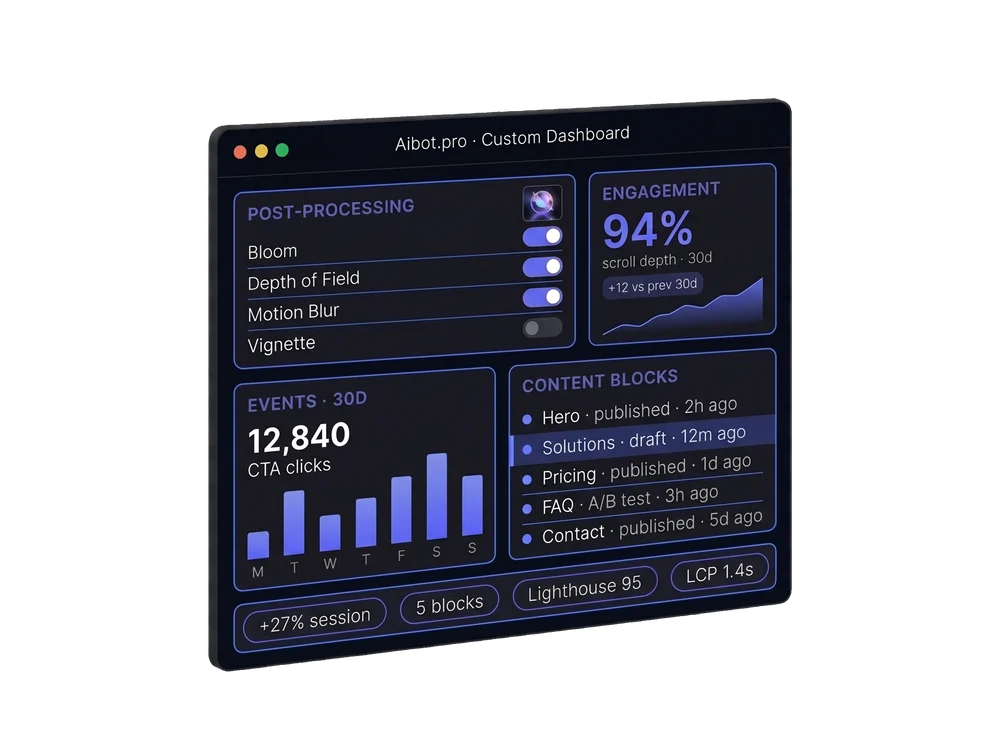
    Shaders and post-processing. Visual effects built for your brand: bloom, depth of field, motion blur, custom shaders. For when you need to go past standard 3D scenes.
  • 02
    Analytics and event tracking. Product analytics that show which blocks pull people in, where they drop off, which CTAs convert. Wired into the stack you already use.
  • 03
    Headless CMS. So marketing can change text, images, meta tags, and A/B tests on blocks without a developer.

A given project may need something else. We decide this at the architecture stage.

Performance · SEO

A WebGL site shouldn't kill your SEO

The big trap with interactive sites: gorgeous on desktop, slow on a phone, and search engines see nothing. 53% of mobile visitors leave a site that takes longer than 3 seconds to load. We build speed and SEO into the architecture from day one.

What we do for performance

01 King metric

First screen first, the rest on scroll

The first screen opens instantly; the other scenes load as you scroll. We compress heavy 3D models 5–7x with no visible loss in quality.

  • First screen opens in seconds
  • 3D loads only when it's needed
  • A hard cap on page weight
02

Adapts to the device

We measure the device's power in milliseconds. Strong devices get the full scene, weaker ones a lighter version, and the oldest a flat version with no 3D.

03

Search engines see all the content

The page's text and structure are ready before the heavy effects fire — search engines see everything. The 3D loads on top and stays out of indexing's way.

04 Bottom line 6 AI platforms with access from day one

Open to AI search crawlers

Many sites block AI bots by default — we open access explicitly and make sure the content is readable. Every key platform gets in:

And more

What we add for SEO

The classic SEO building blocks — set up by default on every project.

01
Schema.org markup
Service · Product · FAQPage · Organization
02
Multilingual setup
hreflang · canonical
03
Sitemap.xml
auto-generated · GSC + Bing
04
Open Graph + Twitter Card
for social sharing
05
llms.txt
on request · for docs-heavy sites

2–8 weeks

From brief to production. Timing depends on how deep the interactivity goes. A simple landing with 1–2 interactive scenes runs 2–3 weeks. A site with full scrollytelling, 4–6 weeks. A complete AI funnel, 6–8 weeks. Bespoke immersive builds run longer — up to 2–4 months.

Process

From brief to production in 2–8 weeks

Hover a row to open the details of that stage.

01 Audit

We break down the job: business goal, ICP, competitive context, performance and SEO requirements. We put together a mood board (3–5 references, each with a reason). Then we lock the direction: marketing site, product UI, or AI funnel.

  • Business goal, ICP, competitive context
  • A mood board of 3–5 references, with reasons
  • A short doc with priorities and a quote
02 Design

We build the design system: typography, grid, color palette, base components. We put together a hero-scene prototype as an animated mockup. We agree on the tone of voice and the character of the interactivity.

  • Design system and base components
  • Hero-scene prototype
  • Sign-off on tone of voice and interactive style
03 Development

We build the site's foundation, write the animations and 3D scenes, and wire in the backend and AI layer if it's needed. Alongside that we tune load speed, search-engine markup, and AI-bot access.

  • Site frame, animations and 3D scenes, backend integrations
  • A speed budget enforced on every build
  • Search-engine markup, AI-bot access, multilingual setup
04 Optimization

We test speed and smoothness on 5 devices: a top iPhone, a mid-range and a low-end Android, a MacBook, a Windows laptop. We check every popular browser. All the key metrics land in the green on phone and desktop.

  • 5 devices: iPhone, mid & low-end Android, Mac, PC
  • Chrome, Safari, Firefox, Edge
  • A speed score of 90+ on phone and desktop
05 Launch

We deploy the site to the server. We hand over the docs and train your team (4–6 hours). Support after that runs on the package you pick.

  • Deploy to the server (our cloud or yours)
  • Docs and 4–6 hours of team training
  • Post-launch support — from €500/mo
Pricing

Transparent pricing

We lock every price at the time you book. Anything beyond that is only agreed-on scope changes. The ROI calculator estimates payback for your own numbers in a minute. Bundle the build with SEO + GEO and you get a discount.

Start · Landing Landing page with light interactivity
from €2,500

exact figure by quote

  • Timeline: 2–3 weeks
  • Landing page or 1–2 pages
  • Hero with light interactivity (GSAP)
  • Optimization for all devices, permissions for AI crawlers
  • For: a specialist or startup that needs a page collecting leads 24/7
Choose Start
Enterprise · Flagship Full WebGL scene and AI funnel
from €20,000

exact figure by quote

  • Timeline: 8+ weeks
  • Full 3D scene across the whole site, a product configurator, and an AI funnel for lead capture
  • 4+ languages, integration with your systems (ERP, CMS, CRM)
  • Deep speed optimization
  • For: a premium service or product company where the site is a tool that sets the company apart from competitors and justifies a high price point
Let's talk
Optional

Two project add-ons, available on request.

Strategy and copy €500–1,500 Building the site's structure and copy: positioning, descriptions of your services or products, and text for every block of the landing page. Counts toward the project cost.
Support €500–2,000/mo A block of hours for regular updates, refinements, and changes to the site. Priority queue, reply within 24 hours. The package rate is lower than the hourly one.

at 1.5% conversion, €200 AOV, +25% conversion uplift · An estimate, not an offer

extra revenue per month
Anti-patterns

What we avoid

The five points below are what we keep seeing in the competitor projects that land on our desk for rework. We sidestep each one from the start of every new build.

01

The site takes 8 seconds to load

Heavy interactivity with no cap ends with a 30 MB first screen: the visitor on a phone waits 8 seconds and closes the tab. We set a page-weight budget and a frame-rate target up front, so the site stays fast a year from now.

53% of mobile visitors leave a site that takes longer than 3 seconds to load. Google · DoubleClick Mobile Speed Study

02

Invisible to Google

If the heavy interactivity loads first, the crawler never sees the page content and drops it from the results. With us, text and structure are ready before the effects fire — the crawler sees all the content, and the 3D loads on top without blocking indexing.

03

The scene breaks on budget phones

The scene looks perfect on a MacBook but runs at five frames a second on a budget Android and stutters. We measure the device's power at the start and serve the right level of detail: the full scene for strong devices, a lighter one for weak ones, a flat version with no 3D for the oldest.

04

Built for desktop only

The designer draws for desktop, the developer builds for desktop, the phone gets checked at the end — and half the scene gets redone. We test on a phone from day one: finger gestures instead of a mouse, no hover-only effects.

05

No way to edit after launch

The site ships without a CMS, so the marketer can't change a headline without a developer. Six months later the copy is stale. We wire in a CMS by default so your team can edit text, images, and banners themselves. The complex interactivity stays with the developer.

FAQ

Common questions

Nine questions we get most often. Don't see yours? Message the CTO or CEO directly.

01 Will the site work on an old phone?

Yes, in an adapted version. On load, we measure the device's power in milliseconds. A modern phone (iPhone 14+, flagship Android) gets the full scene. A mid-range one gets a lighter version. An old or budget phone gets a flat version with no 3D. The content and functionality are the same in every variant — only the visual layer changes.

02 Won't 3D make the site too heavy?

It depends on the approach. The median website in 2025 weighs 2.5–2.9 MB (HTTP Archive). A well-optimized 3D scene adds 0.5–1.5 MB on top of that: source models exported from Blender at 5–50 MB get compressed 10–20x through Draco with no visible loss. The finished interactive page lands at 3–5 MB — on par with a regular site that has a video background or large photos. The heavy parts load after the first screen, so the visitor never waits for the whole scene before seeing the page.

03 How does 3D affect SEO?

On its own, 3D doesn't lift your rankings — Google gives no bonus for interactivity. But with the right architecture, it doesn't hurt them either. The page's text and structure are in the HTML before the heavy effects load, so the crawler sees all the content. The 3D loads on top and never blocks indexing. Search-engine markup and AI-bot permissions are set up by default. The real job is passing Core Web Vitals (LCP under 2.5 seconds): once the page clears them, ranking comes down to content and links, not whether the page has 3D on it.

04 Can we edit content through a CMS?

Yes. We wire in a CMS by default — your marketer changes the text on the site without calling a developer.

05 How long does development take?

It depends on how much interactivity is involved. A landing page with one 3D scene runs 2–3 weeks. A corporate site with an interactive catalog or configurator, 4–6 weeks. A fully custom immersive project with several scenes and your own assets, 2–4 months. Before we start, we lock a calendar with milestones — you see what ships and when.

06 How much does a website cost?

It depends on scope and how deep the interactivity goes. A landing page with light interactivity starts at €2,500, a multi-page site or premium interface at €6,000, a full WebGL scene or AI funnel at €20,000. We lock the exact quote at the audit stage, fitted to your needs, with no hidden charges beyond the agreed scope. The ROI calculator estimates payback in a minute.

07 Can you use my own 3D model?

Yes. We take models from Blender, Cinema 4D, Maya, ZBrush in GLTF / GLB / FBX / OBJ. We adapt them for the web: geometry compressed through Draco (usually 10–20x with no visible loss) and textures optimized so the model loads fast. If you already have rendered stills or video assets, we fold them in as extra layers.

08 How much does support cost after launch?

Support — from €500/mo: a block of hours for regular updates, fixes and changes; priority queue, response within 24 hours. The first week after launch is free.

09 Do you do a website redesign?

We do, but only when a rebuild is justified. People often come to us asking to rewrite everything from scratch, and after the audit it turns out targeted work is enough: speed it up, redo the first screen, adapt it for mobile. We tell you straight how much work you actually need, and we don't sell a redesign for its own sake.

Contact

Book a free 20-minute audit call

We'll go through your goals and your current site (if you have one), size the budget against the scope, and send back a short report with a proposed architecture. No strings attached.

Your data stays safe. The audit commits you to nothing. By submitting, you agree to our privacy policy.